Teneo’s Client Advisory Board on repeat destinations, trusted relationships, and the operational confidence that separates good programs from exceptional ones
With more than a decade connecting meeting planners to a curated global portfolio of over 350 independent hotels, resorts, and destination management companies, Teneo Hospitality Group occupies a vantage point that few organizations in this industry share. Positioned at the intersection of planner need and property capability – with visibility into the decisions happening on both sides – Teneo sees, in real time, what is actually shaping how business gets placed. And one pattern the team has been tracking with increasing attention is this: in a market defined by uncertainty, the planners executing at the highest level are not always the ones chasing new ground. They are the ones who know exactly where they stand.
There is a version of destination strategy that looks great in a presentation deck – new markets, bold programming, the allure of somewhere no one has been before. And then there is the version that actually works under pressure: one built on operational intelligence, trusted partners, and a clear-eyed read of exactly what a destination can and cannot deliver. For the planners in Teneo’s community, these two things are not always in conflict. But increasingly, the data and the instinct point toward a third path: familiarity as a strategic asset, not simply a comfort zone.
Teneo Hospitality Group asked members of its Client Advisory Board to weigh in on how destination familiarity shapes their planning process – and the results are illuminating. Across a range of program types, client profiles, and organizational mandates, a consistent set of themes emerged. What follows is an exploration of those themes, and what they suggest about the direction of destination selection in 2026 and beyond.

Orlando, Florida
The Expert Knows What They Are Selling
Before it ever becomes an operational advantage, destination familiarity is a credibility asset for the planners Teneo works with. Those who have walked the property, eaten the food, and absorbed the energy of a place can speak to it in ways that RFP decks and virtual tours cannot replicate.

Credibility Counts
That firsthand knowledge does not just strengthen a recommendation – it accelerates client confidence. When a planner can speak to the nuances of a destination, its service culture, its seasonal rhythms, its logistical quirks, that credibility collapses the decision timeline and reduces the back-and-forth that slows programs down.
Equally telling: advisory board members who lacked direct experience described a recalibration of trust. Without personal knowledge, they relied more heavily on their GSO contacts, peer networks, site visit quality, and the professionalism of the hotel sales team – themselves a form of borrowed familiarity. Familiarity, it turns out, is always present in a decision. The question is simply whose familiarity is doing the work.
Teneo Perspective
This is precisely why the Teneo Summit and TrueTours program exist – to give the planners in Teneo’s network direct, curated destination experience before an RFP is ever written. When Teneo invests in building that familiarity on behalf of its planner community, everyone in the relationship benefits: the planner brings greater confidence to the conversation, the property earns a more informed advocate, and the client gets a recommendation grounded in real experience. Familiarity acquired through trusted relationships is still familiarity. Confidence compounds.
The Site Visit Is Non-Negotiable – But Its Function Has Evolved
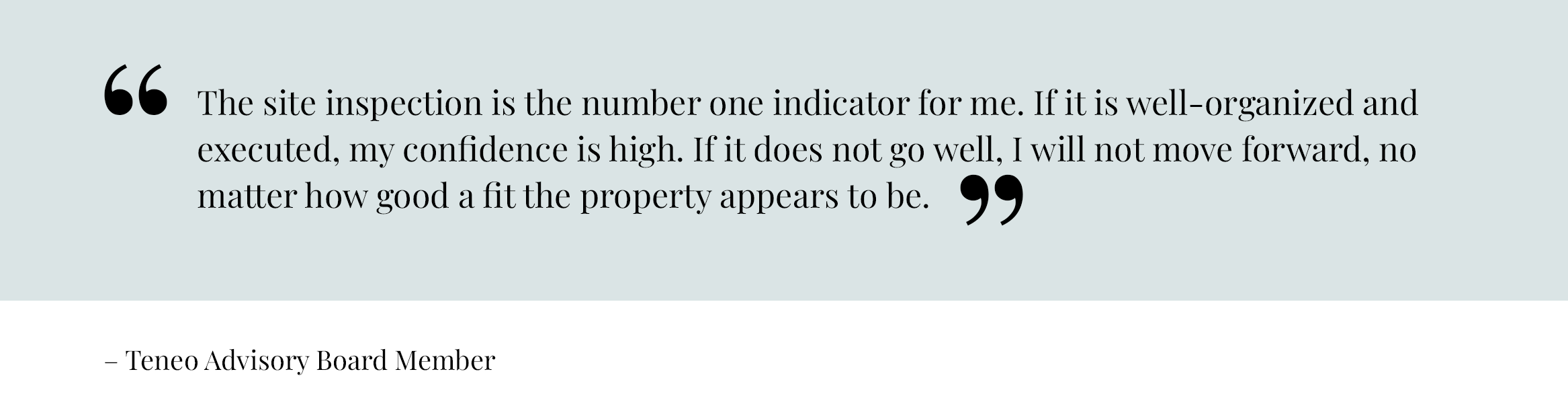
Ask any experienced planner what builds confidence in a new destination, and the site visit will appear within the first two sentences. It remains the gold standard for evaluation. But what advisory board members described was something more nuanced than a checkbox: the site visit as a diagnostic tool, not just an orientation.
Look Beyond the Tour
Several planners described a deliberate strategy of visiting properties incognito – or at minimum, stepping away from the sales escort to experience a destination as a guest would. The logic is direct: the curated version of a property is useful, but the unfiltered version is what matters for a group of two hundred people who did not sign up for a site tour.
Contract negotiation earned repeated mention as a secondary signal – perhaps the least glamorous indicator, but one of the most predictive. If negotiations are difficult and prolonged, that friction rarely resolves itself after signatures. It tends to show up again in the execution phase, and then in the room. The Teneo community of planners treats the deal-making process not just as a transaction but as a preview of the relationship.

Las Vegas, Nevada
Repeat Destinations Are Not Defaults – They Are Earned
The incentive industry has long wrestled with the tension between novelty and reliability. Attendees want new experiences. Clients want exceptional outcomes. Planners want manageable risk. These forces do not always align – and the most effective planners in Teneo’s community have become skilled at navigating the gap.
What advisory board members described was not a preference for repetition in itself, but a recognition that certain destinations and properties have earned their return visits – through service consistency, a willingness to listen, and the capacity to evolve even within a familiar setting.

The Return Advantage
This portrait of a productive repeat relationship captures something important: properties that continue to refresh themselves earn loyalty from the planners who bring business to them. Those that go static lose it. The obligation any planner carries to their client is not familiarity – it is excellence. When a destination continues to deliver that, return visits follow naturally. It is one of the clearest patterns Teneo observes in how its most experienced advisory board members manage their portfolios.
For larger programs – those in the 800-plus attendee range – the calculus shifts further. Properties capable of accommodating those groups are fewer in number, and the investment in vetting a new venue is proportionally higher. Here, familiarity becomes less a preference and more a structural reality of the market.
The Relationship Layer: More Fragile Than It Looks
If there is one finding from the advisory board that deserves particular attention in Teneo’s conversations with hotel and venue partners, it is this: the relationships that underpin destination familiarity are increasingly vulnerable to turnover. And the industry’s current pace of staff transition is real.
One board member described booking a property for five years through Teneo and arriving at year two having cycled through three CSMs, five DMC sales reps, and counting. The relationship continuity, she noted, plays no role at all when turnover is that rapid. This is not a cynical observation – it is a pragmatic one, and it carries a direct implication for the hotel and venue partners in Teneo’s portfolio: relationship equity is built slowly and lost quickly. The planners in Teneo’s community are paying attention.
From the Field
When a program in Mexico required a six-week pivot due to regional concerns, one advisory board member relied entirely on the trust built with a Four Seasons sales manager – who relocated the group to Nevis, mitigated cancellation damages, and connected the team with a local DMC partner. No site inspection. No prior experience with the destination. The outcome was exceptional.
The relationship was the insurance policy. It is a story the Teneo team returns to often – because it illustrates precisely the kind of trust Teneo works to build between planners and the properties and partners in its portfolio.
This story illuminates something the data confirms: relationship trust is not just a soft asset – it is operational infrastructure. When a planner trusts a person, they are trusting that person’s judgment, network, and willingness to go beyond the transaction to protect the program. That is a form of confidence no FAM trip can fully replicate. It is also the standard Teneo holds its hotel and venue partners to when making introductions on a planner’s behalf.
Several advisory board members cited high staff turnover at both hotel properties and DMC partners as a complicating factor they now track proactively. High turnover, one noted, signals a problem. In an environment where relationships are the currency, instability within a partner organization is a legitimate risk factor – one that Teneo actively monitors across its portfolio.

Nashville, Tennessee
What Teneo Sees Working When Planners Enter Unfamiliar Territory
Most planners in Teneo’s community venture into new destinations deliberately – and when they do, the question becomes how to generate the operational confidence that familiarity would otherwise provide. The advisory board’s collective approach is layered and methodical.
Peer referrals and intelligence from trusted industry partners come first, followed by independent research, then an on-site experience – ideally at a granular, unescorted level. CVB and DMO engagement was cited as valuable for contextual intelligence: understanding what is happening in a city in terms of major events, infrastructure changes, and competing programs, rather than as a primary driver of destination selection. This distinction matters for how Teneo positions destination support resources in its conversations with both planners and its destination partners.
Several members described a structured evaluation process that blends attendee data with on-the-ground validation – the goal being to generate the operational confidence that familiarity delivers, through methodical alternative means, with full awareness of the additional work that always comes with the unknown.
That phrase – eyes wide open – is worth sitting with. It encapsulates a kind of professional maturity about risk: not avoidance, but calibration. The most effective planners in Teneo’s network are not afraid of new destinations. They simply understand what the work involves, plan accordingly, and expect their partners – including Teneo – to be equally clear-eyed about what a new destination will require.
The Competitive Edge Is Clarity
What emerges from the advisory board’s collective wisdom is not a case against novelty, nor an argument for comfort. It is something more precise: a recognition that familiarity – when earned through experience, sustained through trusted relationships, and validated through rigorous evaluation – is a form of competitive advantage that benefits everyone in the room.
Planners who can speak with authority about a destination close faster, negotiate better, and execute with greater confidence. Properties that invest in relationship continuity, service consistency, and a genuine willingness to incorporate feedback earn repeat business not through inertia but through performance. Destinations that support planners with transparent information, strong local partners, and reliable infrastructure become the foundation of long-term strategic thinking – and the preferred destinations Teneo brings back to its planner community again and again.
In a market where reliability is not guaranteed and the pace of change continues to accelerate, knowing where you stand – and who stands with you – is not a small thing. It is, increasingly, the edge.
Coming in Part 2
Teneo examines how planners are balancing the push for new destination experiences with client expectations – and what properties and cities are doing to earn their place in the consideration set for the first time.